
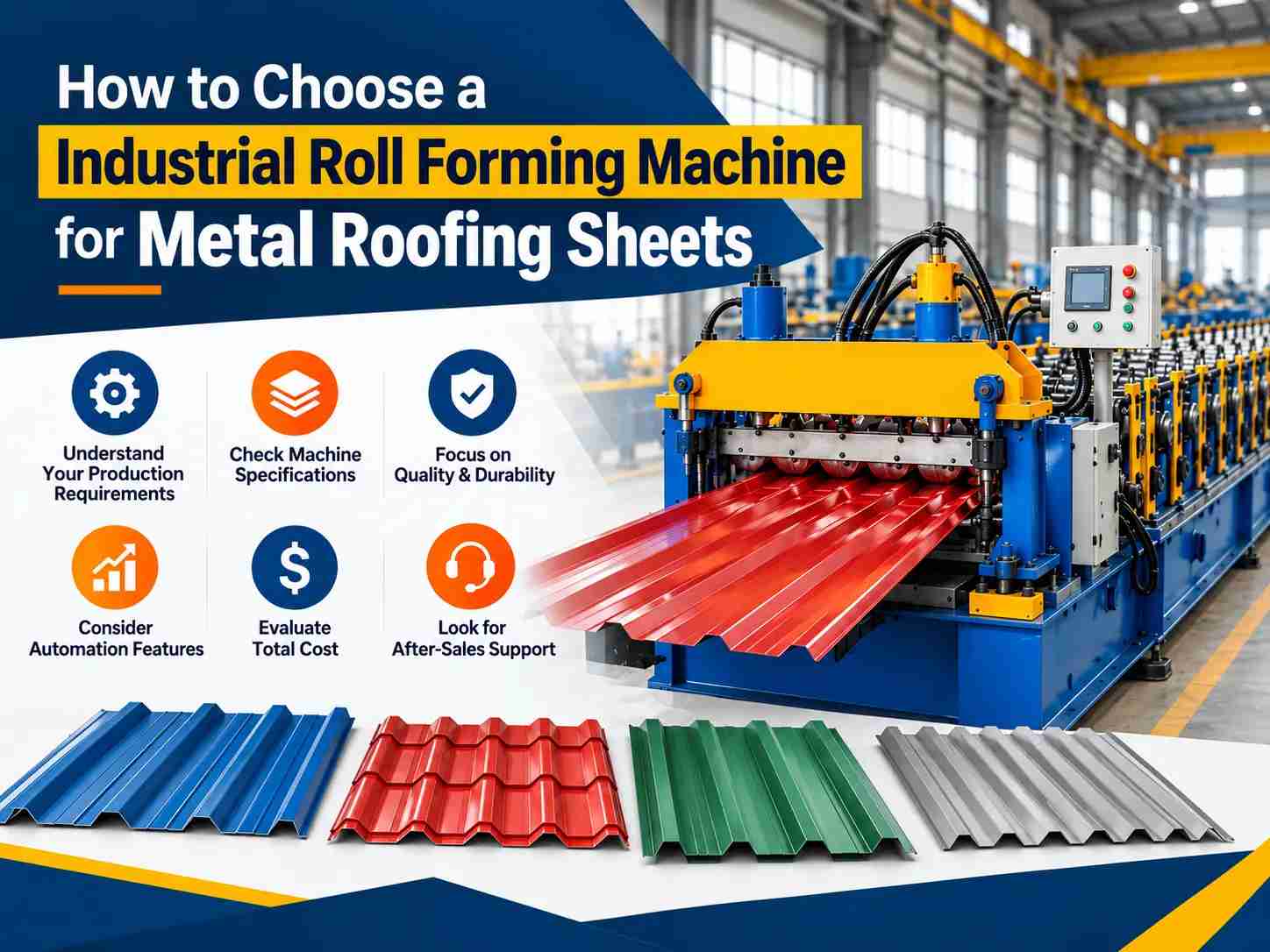
How to Choose a Industrial Roll Forming Machine for Metal Roofing Sheets
You want to make roofing sheets. You need the right machine for the job. An Industrial Roll Forming Machine takes a flat metal coil and bends it into a roof shape. Then it cuts the sheet to size.
But which machine should you buy? Start with six checks. Look at your roof profile, your metal thickness, and your speed need. Then check the number of roller stations, the control and cutting system, and the roller quality. A PLC is a small computer that runs the machine, so pick one that is easy to use.
The right Metal Roll Forming Equipment gives you clean sheets. Good Roll Forming Machinery also saves power and cuts waste.
Let’s go step by step.
What Is a Industrial Roll Forming Machine for Metal Roofing Sheets?
A Industrial roll forming machine for metal roofing sheets turns a flat metal coil into a roof sheet.It gradually bends the metal. Then it cuts each sheet to your set length. This Sheet Metal Forming Machine makes the same profile again and again, fast.One continuous method of producing metal is roll forming. You load the coil on the decoiler. The metal moves through many roller sets, and each set bends it a little more. Then the cutter trims the sheet. Industrial Roll Forming Machine applications include roofing sheets, wall panels, purlins, door frames, and storage racks.
Which Roofing Sheet Profiles Do You Need to Produce?
First, decide which roofing sheets you want to make. Make a list of the shapes your customers buy most. Every shape needs its own set of rollers. So one machine cannot make all shapes. This is the initial stage in producing sheet metal profiles.
Common roofing shapes:
- Trapezoidal sheet: Has flat tops and sloped sides.
- Corrugated sheet: Has smooth waves.
- Tile-effect sheet: Looks like clay roof tiles.
- Standing seam panel: Has raised joints that lock together.
Check before you buy:
- Rib height: How tall is each ridge?
- Cover width: How wide is the sheet after fitting?
- Future orders: Will you add new shapes later?
Some machines make two shapes on one frame. This helps if you sell more than one type.
What Metal Thickness Should the Machine Support?
The machine should support your thickest and thinnest coil. Most roofing sheets use metal between 0.3 mm and 0.8 mm. A machine built for thin metal wears out fast on thick metal. Always check the thickness limit before you buy.
Materials vs Thickness Range
|
Material |
Typical Thickness Range |
|
Galvanized Iron (GI) |
0.30 – 0.80 mm |
|
Galvalume (GL) |
0.30 – 0.70 mm |
|
Pre-painted Steel (PPGI) |
0.25 – 0.60 mm |
|
Aluminium |
0.40 – 1.00 mm |
|
Copper |
0.30 – 0.80 mm |
Why Thickness Matters
- Thick metal needs strong rollers and shafts.
- Thick metal needs a bigger motor, often 5.5 kW to 7.5 kW.
- Thin metal needs fine roller settings. Wrong settings cause wavy sheets.
- A wrong match cracks paint and damages rollers.
What to Check Before You Buy
- Coil width: Most roofing coils are 1,000 mm to 1,250 mm wide.
- Yield strength: This is the force metal takes before it bends for good. Roofing steel is often 250 to 550 MPa.
- Coating: Zinc and paint coats need smooth rollers. Rough rollers scratch them.
Which Roll Forming Machine Capacity Suits Your Production Needs?
Pick a capacity that matches your daily orders. Capacity means how many metres the machine makes each minute. Most roofing lines run at 10 to 25 metres per minute. A faster machine costs more, so do not overbuy. Buy the speed you need today, with a little room to grow.
Capacity Guide by Plant Size
- Small workshop: 8–12 m/min
- Mid-size plant: 12–20 m/min
- High-volume plant: 20–30 m/min
Why Motor Power Matters
- Most lines use motors from 3 kW to 7.5 kW.
- A bigger motor handles thicker metal.
- A weak motor slows the line and wears out fast.
- This power range suits roll forming machine for roofing sheet manufacturing at most scales.
How to Pick Your Speed
- Examine your everyday orders: How many sheets do you sell every day in meters?
- Count your work hours: Multiply the speed by the hours you run the machine.
- Plan for growth: Add 20% to 30% extra capacity.
We manufacture all these types.
How Many Forming Stations Are Required for Roofing Sheets?
Most roofing sheets need 10 to 24 forming stations. A forming station is one pair of rollers. Simple profiles need 10 to 14 stations. Complex profiles need 16 to 24. Each station bends the metal a little more. More stations give you a smoother, more exact sheet.
Think of it as small steps. A flat strip cannot turn into a deep rib in one move. So the machine bends it by about 5° to 15° at each station. Shallow shapes like corrugated and trapezoidal sheets need fewer steps. Deep shapes like tile-effect and standing seam panels need more.
Four things decide your station count:
- Rib depth: Deeper ribs need more stations.
- Metal thickness: Thick metal resists bending, so it needs smaller steps.
- Coating: Painted and coated steel needs gentle bends to avoid cracks.
- Metal strength: Harder steel springs back, so it needs more stations.
What too few stations cause:
- Wavy edges
- Cracked paint or coating
- Uneven panel width
- Twisted or bowed sheets
- Faster roller wear
What extra stations cost you:
- A longer machine, often by 1 to 3 metres
- A higher price
- More rollers to maintain
Ask the maker how many stations your profile needs. Ask for a sample sheet from the same profile. Check the sheet for flat edges and clean paint. A good Metal Profile Forming Machine bends the sheet in small, gradual steps. This keeps the sheet flat and the coating safe.
How to Evaluate Roller Quality and Roofing Sheet Accuracy?
Choose a single-layer machine if you make one main profile. Choose a double-layer machine if you sell two profiles often. A single-layer machine has one roller set and makes one profile. A double-layer machine stacks two roller sets on one frame. You switch between profiles in minutes, with no hand changes. This saves floor space and money.
Think about your orders. Do customers ask for two shapes, like trapezoidal and corrugated sheets? Then double-layer fits you well. It suits roll forming machine for metal roof panel production. Does one profile make up most of your sales? Then single-layer is enough.
Key differences:
- Single-layer: Lower price, simple to run, short machine body.
- Double-layer: Two profiles on one machine, quick switch between them, needs more floor height.
- Cost: Double-layer costs more at the start, but less than buying two machines.
Need a machine for this profile? Talk to our engineers.
Which Control System and Cutting Mechanism Should You Consider?
Pick a PLC with a touchscreen and a cutter that fits your speed. A PLC is a small industrial computer that runs the machine. It sets the sheet length and the line speed. A touchscreen is easy to learn. It cuts operator errors. Choose a hydraulic or flying cutter based on your output.
Good length accuracy is within ±1 mm. Ask the maker for a trial run to check it. This matters for any Industrial Metal Forming Equipment. Sheets that vary in length waste metal and slow down fitting on the roof.
Key options:
- PLC with touchscreen: Set length, speed, and sheet count in one screen.
- Hydraulic cutter: Strong and gives a clean cut. It stops the sheet for a moment. It suits lines up to about 15 m/min.
- Flying cutter: Cuts while the sheet keeps moving. It is faster and suits high-volume lines.
- Safety features: Look for an emergency stop and guard covers.
Ask for a PLC from a trusted brand. Spare parts and service are then easier to find.
How to Evaluate Roller Quality and Roofing Sheet Accuracy?
Check the roller material, the surface finish, and a sample sheet. Rollers decide the quality of every sheet. Good rollers use hardened steel and often have a chrome plating. They last longer and leave no scratches. A flat, sharp sample sheet shows a well-built machine.
Poor rollers wear out fast. They scratch the coating and give uneven sheets. Good rollers keep the same shape for years. So check them before you pay.
What to check:
- Roller material: Look for steel like Cr12 or GCr15. These resist wear.
- Surface finish: The rollers must feel smooth and polished.
- Shaft strength: A strong shaft does not bend under load. Ask for the shaft size in mm.
- Sheet width tolerance: Aim for ±1 mm.
- Sample sheet: Look for twists, waves, and paint marks.
Ask the maker to run a trial and show you the sheet. Measure the width and length yourself.
What Factors Affect the Cost of a Roofing Sheet Roll Forming Machine?
The cost depends on the machine’s build and features. A basic line costs less. A full automatic line costs more. More stations, thicker metal, and better rollers all raise the price. Know these factors before you ask for quotes.
A cheap machine can cost you more later. It often uses weak rollers and a small motor. These wear out fast and need repairs. So look at the total cost, not just the first price.
Main cost factors:
- Number of stations: More stations mean a longer, costlier machine.
- Metal thickness limit: Thicker metal needs stronger parts.
- Single or double layer: Double-layer costs more at the start.
- Motor power: A bigger motor, like 7.5 kW, costs more than a 3 kW one.
- PLC and cutter type: A flying cutter costs more than a hydraulic one.
- Roller material: Hardened, chrome-plated rollers cost more but last longer.
- Extras: A decoiler, stacker, and run-out table add to the price.
Ask each maker to list what their price includes.
How to Compare Roll Forming Machine Specifications Before Buying?
Put every quote in one sheet and compare the same points side by side. Do not choose on price alone. Check the warranty and the after-sales support too. Visit the factory if you can. A clear comparison helps you pick the best machine for your money.
Compare these points:
- Profile and thickness range: Does the machine match your sheets and coils?
- Speed and motor power: Does it meet your daily output?
- Station count: Does it suit your profile?
- Roller material: Is it hardened and polished?
- Warranty period: Aim for at least 12 months.
- Spare parts and service: Can the maker fix it fast?
Still unsure about roll forming? Here is a short look at how it compares with a press brake. A press brake is a machine that bends metal one fold at a time.
Roll Forming vs Press Brake
|
Feature |
Roll Forming |
Press Brake |
|
Speed |
Very fast, continuous |
Slow, one bend at a time |
|
Best for |
Long, repeat profiles |
Short, custom parts |
|
Labour |
Low |
Higher |
|
Cost per sheet |
Low at volume |
High at volume |
For roofing sheets, roll forming wins on speed and cost.
Ready to Choose the Right Machine?
Tell us your roofing profile, metal type, and output target. Our engineers will suggest the right setup for you.
For over 10 years, Rajpoot Machine Pvt. Ltd. has built roll forming machines for Indian plants. Our team in Ghaziabad guides you from the first call to the first sheet. We also give you technical support after the sale.
Get a free quote or Talk to our engineers today.
Frequently Asked Questions
Find answers to common questions related to this topic.